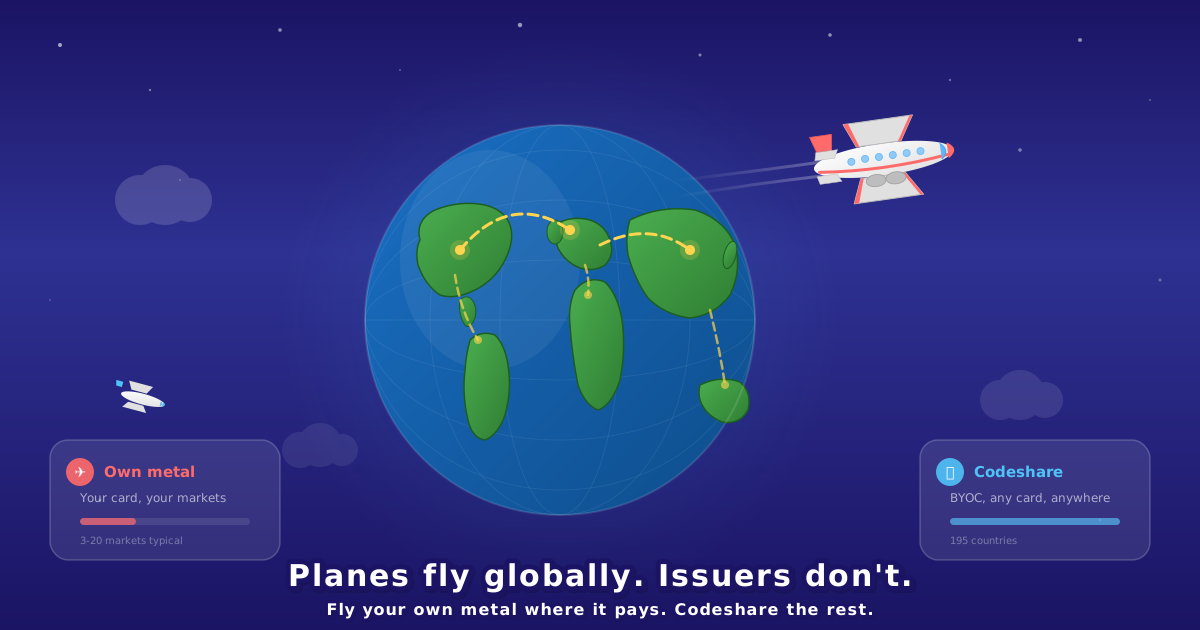
An airline cannot fly wherever it wants. Traffic rights are negotiated country by country, and no carrier holds them everywhere. So airlines run two models at once.
On trunk routes, where they have density and volume, they fly their own aircraft. They own the metal, control the experience end to end, and keep the full margin. It is capital intensive and operationally heavy, and on those routes it is unambiguously worth it. Everywhere else, they codeshare, putting their code on someone else's aircraft to sell you a ticket to a country where they have no planes, no crew, and no landing rights.
No airline executive worries that codesharing cannibalises their own flights. The network is what makes the airline worth choosing, and codeshare routes feed traffic onto the metal.
Card issuing works much the same way, down to the licences being granted country by country. Most spend platforms only build the metal. Which makes it worth asking how far the metal actually goes.
Nobody issues everywhere
Every card issuing platform describes itself as global, and by any reasonable standard most of them are. But "global" in issuing means something narrower than the word implies. Here is what the providers publish about themselves.
| Provider | Headline company reach | Issuing / issuer-processing reach |
|---|---|---|
| Adyen | Payment acceptance in nearly 100 countries | Issuing supported in the EEA, UK and US |
| Stripe | 46 fully supported countries | Issuing in 20 European countries plus the UK, and the US |
| Marqeta | Certified to operate in 40+ countries | Same 40+; European licence via TransactPay, live in 25 countries at acquisition |
| Thredd | 130+ clients across 47 countries | 44 countries per the Visa partner directory, over 50 per its own docs |
| Paymentology | Experts on the ground in 60+ countries | Issues and processes in over 50 countries, 65+ per its LinkedIn |
| FIS Total Issuing (incl. TSYS) | 20,000+ clients worldwide | No clean published country count |
Three things stand out, none of them obvious from the headline numbers.
Issuing reach is a fraction of company reach
Adyen is the clearest case, and the figures are Adyen's own. It handles payment acceptance in close to 100 countries. Its issuing product is supported in 3 markets: the EEA, the UK, and the US. Same company, same licences, same network relationships, and a fraction of the footprint.
Stripe has the same shape. The company supports businesses in 46 countries. Stripe Issuing launched across 20 European markets plus the UK, on top of the US. Strong for a card product, and still less than half of where Stripe itself operates.
This is structural rather than a shortcoming. Issuing is harder to scale geographically than acquiring, because it requires a licence to put money into a market rather than take it out, and every jurisdiction has its own view on who may do that. It is the payments equivalent of selling tickets to a country versus being allowed to land there.
The practical takeaway: acceptance and issuing are separate licences with separate footprints. Your provider processing payments in a market does not mean it can issue cards there, and the gap between the two is where expansion plans tend to slip.
The numbers are not comparable to each other
Look closely and the providers are answering different questions. "Certified to operate in" is a network certification claim. "Processes transactions across" is about volume. "Clients across" counts where customers are domiciled, not where programs can launch. "Experts on the ground in" is headcount. Four different statements, often read as one metric.
The variation shows up within single companies. Thredd's materials say 44, 47, and 50-plus countries depending which page you land on. Paymentology says over 50 in one place and 65-plus in another.
This is not vendor dishonesty. There is no standard definition of supporting a market. Support depends on which licence, which BIN sponsor, which card type, which currency, and whether physical cards need local fulfilment. A provider can accurately support a market for one program and not for yours, which makes country counts close to unusable as a comparison. The figure that matters is how many of your target markets a provider covers for your program type, and that only comes out of a scoping call.
The map moves underneath you
The reasonable response is to do the diligence and pick the partner whose perimeter matches the plan. Except perimeters are not fixed.
FIS closed its $13.5 billion acquisition of Global Payments' Issuer Solutions business, formerly TSYS, in January 2026, creating what it calls the world's largest issuing business. Marqeta acquired TransactPay in August 2025 to bring a European EMI licence in-house.
Both deals are rational and both will likely improve the product. But if you signed a multi-year contract on the basis of a particular roadmap, that roadmap now sits inside a much larger integration, and your expansion timeline is one priority among many.
The processors are candid about this themselves. Carta Worldwide, an issuer processor, noted in its own marketing years ago that being present in every country is uncommon, and advised prospective customers to ask how a processor handles entering new territories.
What stepping outside the perimeter costs
Inside a provider's licensing perimeter, adding a market is close to a configuration change. Outside it, you are assembling a stack: potentially a new BIN sponsor or bank partner, since an EEA licence does nothing for you in Brazil or Singapore or the UAE, plus a second processor if your primary is not certified locally, in-region network certification, local scheme rules, jurisdiction-specific KYB and AML, settlement and currency mechanics, card fulfilment logistics, and reporting granular enough for local tax treatment.
Then it compounds, and this is the part that gets underestimated in planning. The moment one market falls outside your primary provider's perimeter, you add a second provider. Now you maintain two contracts, two compliance relationships, two escalation paths, and two transaction payloads that disagree about what a merchant name is and whether a refund is its own object.
Your data model fragments along the same lines as your provider map. The real cost of the fifth market is not the launch. It is the normalisation layer you own forever, and the features you cannot ship consistently because the data underneath them is inconsistent.
Where to fly your own metal
None of which is an argument against issuing your own card. It is an argument about where.
Your card is your trunk route. It belongs in your home and largest markets, in segments where the card is genuinely part of the product and you need to approve or decline at authorisation, and anywhere you have enough spend concentration for interchange to be material and enough customers to amortise the compliance overhead. In those places, own the metal. The economics are good, the control is real, and the operational weight is worth carrying.
BYOC is the codeshare layer
Bring Your Own Card covers the rest of the network: cards you did not issue, in markets where you hold no licence, for customers with no intention of moving a banking relationship tied to credit facilities they will not renegotiate for the sake of an expense tool.
Two things make it infrastructure rather than a stopgap:
Data quality and structure. Level 3 fields, accurate MCCs, real merchant detail, taken at the network level from Visa, Mastercard and Amex rather than inferred from a bank feed or guessed at by an aggregator. The same schema regardless of which bank issued the card or where, so one data model instead of one per provider.
One integration instead of a provider map. No additional BIN sponsor per region, no incremental network certifications, no third payload format to reconcile. Real-time coverage across authorisation, clearing, settlement, voids and refunds comes with it, though it is the depth and consistency of the data that determines what you can build on top.
And like a codeshare, it feeds the metal. Land an account on BYOC in a market your card reaches in eighteen months, run the software, build the spend history. When the card arrives, you are making the case to an existing customer with their own data in front of them.
The point
No issuer processor covers every market you want to enter. On their own published figures, the broadest reach in the category lands between 40 and 65 countries out of roughly 195, using definitions that do not quite reconcile and perimeters that can shift with an acquisition.
Build international growth entirely on issuing and your addressable market is bounded by someone else's licensing footprint, while your data quality is bounded by however many providers you stitched together to work around it.
Fly your own metal where it pays. Codeshare the rest.
A note on the figures above: all are self-reported by the providers, drawn from their own documentation, press releases, and partner listings as of July 2026. They are not directly comparable, which is one of the arguments of this piece. We could not find a published issuing country count for FIS Total Issuing and have not estimated one.
Astrada connects platforms directly to Visa, Mastercard and Amex to deliver structured, real-time card transaction data through a single API, with no card issuance required. If you are scoping international expansion and want to work out which markets justify your own program and which do not, we are happy to talk.