About ten years ago, software companies started issuing their own credit cards.
They didn't do it because they wanted to be in the card business. They did it because it was the only way to see what their customers were actually buying.
That was the right call at the time. I know, because I helped sell it. It is also about to become the biggest constraint these companies have.
Why Anyone Issued a Card in the First Place
I started my career in fintech at Marqeta in 2017. My job was to find a market for a modern card issuing platform, and we found one almost immediately in expense management. Every one of those companies wanted to issue its own card. Ramp, Brex, and a dozen others were built on exactly that idea.
The reason wasn't the money, though the money helped. It was visibility.
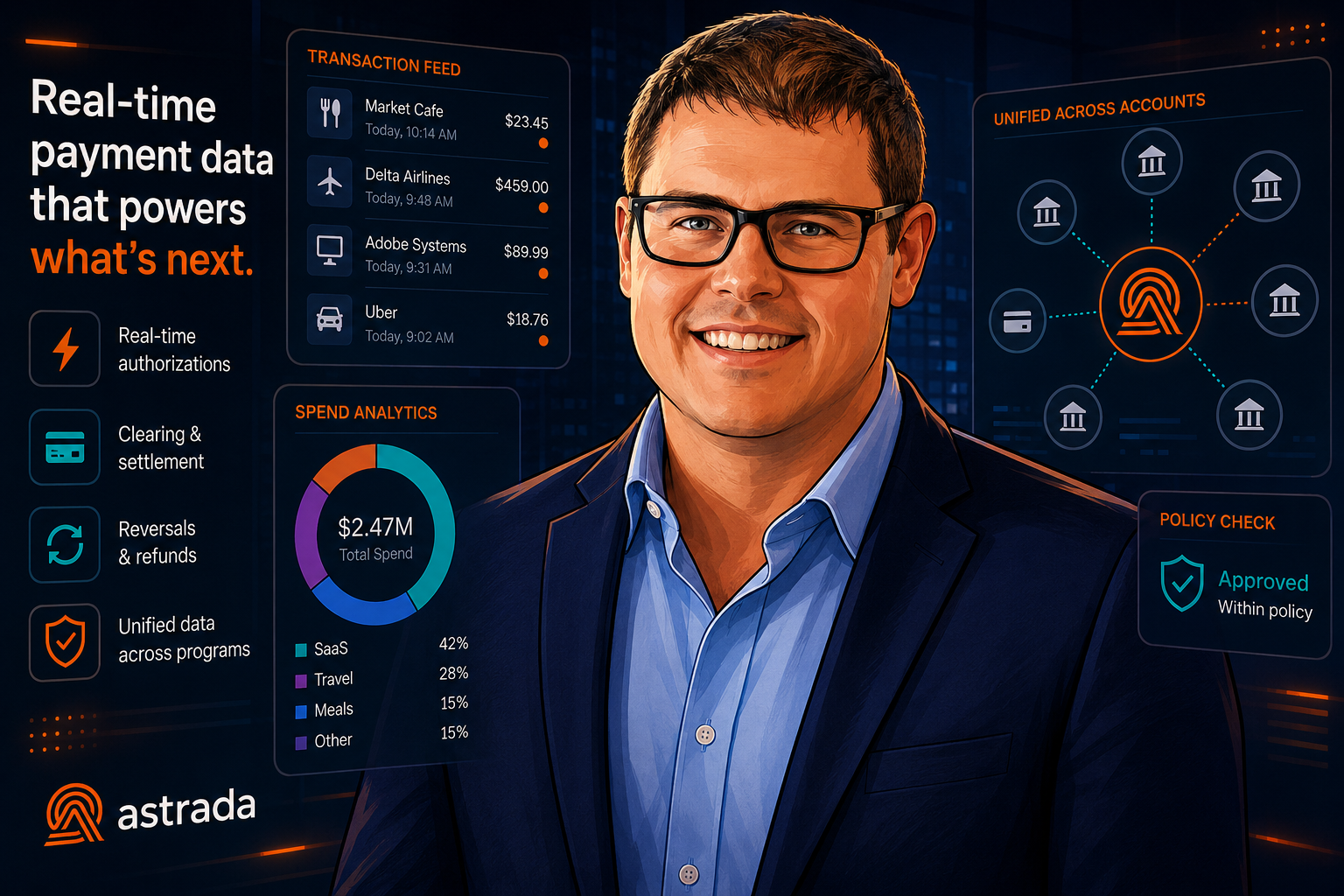
When you issue the card, you see a purchase the instant it happens, with everything the payment network knows about it attached: what kind of business the merchant is, where it is, sometimes what was actually bought. When you don't issue the card, you get whatever the bank decides to pass along a day or two later, which is usually a name and a dollar amount.
Own the card, own the data. At the time there was no second way to do it.
Everyone Is Now Building Everything
Fast forward to today and none of these companies describe themselves as expense platforms anymore.
Ramp shipped three products last quarter: software agents that find vendors and review contracts, an AI system built for accounting firms, and a tool for tracking what companies spend on AI itself. Any one of those would have been an entire company five years ago.
They aren't alone. Bill payment companies issue cards. Card companies offer banking. Travel companies sell purchasing software. Accounting software enforces spending rules. Navan went public as a travel company that is also a payments company. American Express bought Center in 2025. Xero bought Melio.
The usual explanation is that finance teams want fewer vendors, so everyone is racing to be the last one standing.
That's part of it. But look at what each of these expansions actually buys.
Bill payment shows you what a company agreed to spend before any money moved. Cards show you the moment it spends. Banking shows you what's left over. Purchasing software shows you what someone intends to buy, which is the earliest signal there is. Accounting shows you how all of it gets classified.
Nobody is buying a product line. Everybody is buying a piece of the picture.
Where Owning the Card Runs Out
Owning the card shows you the spending that goes on your card. That's the whole catch, and it's a big one, because almost no company puts all its spending in one place.
There's the American Express the CEO won't give up. A regional bank card for the European office, because the local bank required it. A purchasing card sitting in a drawer in the facilities department. Employees paying for things personally and expensing them later.
This isn't a hunch. Codat surveyed 500 finance leaders at US companies with revenue between $10 million and $1 billion. Half work with three or more banks. More than two thirds work with more banks than they did five years ago. Even the company's main bank handles only about 63 percent of its financial services.
The number of places a company keeps its money is going up, not down.
So a platform that only sees its own card is watching a shrinking piece of a growing picture. That was survivable when the software's job was to produce a report at the end of the month. A partial report is still a useful report.
It stops being survivable now.
What Changed
Every company in this category is building AI agents. Categorize the purchase. Enforce the policy. Chase down the receipt. Reconcile the account. Close the books.
The agents themselves are good. The information underneath them is where these projects die, and it fails in three ways.
They can't see everything. An agent that sees half a company's spending can't be trusted with any of it. A person who hits a gap in the data asks someone. An agent who hits a gap guesses. No finance leader is going to let that run unsupervised, which means it stays a suggestion engine rather than something that actually does the work.
They can't see enough. The payment networks carry real detail about a purchase: the type of business, the location, sometimes a line by line breakdown of what was bought. Almost none of that survives the trip into most software. What arrives is a merchant name and an amount, and often a mangled one. Anyone who has stared at something like "SQ *TST MERCH 4471" on a statement knows the problem. Software trying to categorize that isn't classifying a purchase. It's guessing at a puzzle.
They see it too late. Most platforms learn about a purchase a day or two after it happens. That's fine for a person reconciling at month end. It's useless for software whose job is to stop a purchase that breaks policy, because by then it isn't stopping anything. It's writing it up.
An agent is only as good as the weakest of those three. And none of them get fixed by a better model. You can't prompt your way past information that never arrived.
What It Means
When every platform ships every feature, features stop being the thing you win on. Matching a competitor's product now takes a few months, not a few years. What's left is what your software actually knows, across everything a customer spends rather than just the part you handle.
The fair objection is that data you didn't originate will never be as clean as data you did. There's something to that. Piecing together a complete picture of spending you didn't process is harder than reading your own. But it's a solvable engineering problem, and it's a far cheaper one than convincing every customer to move their banking before they can use your software.
Being open isn't a feature you bolt on later. It's a decision about how your software gets its information, made long before any of the AI ships, and it decides whether that AI works.
That's the problem we spend our time on at Astrada, so weigh my view accordingly. But the question holds no matter who's asking it. If everyone has the same features, and how much your software can do depends on how much it can see, what exactly are you competing on?