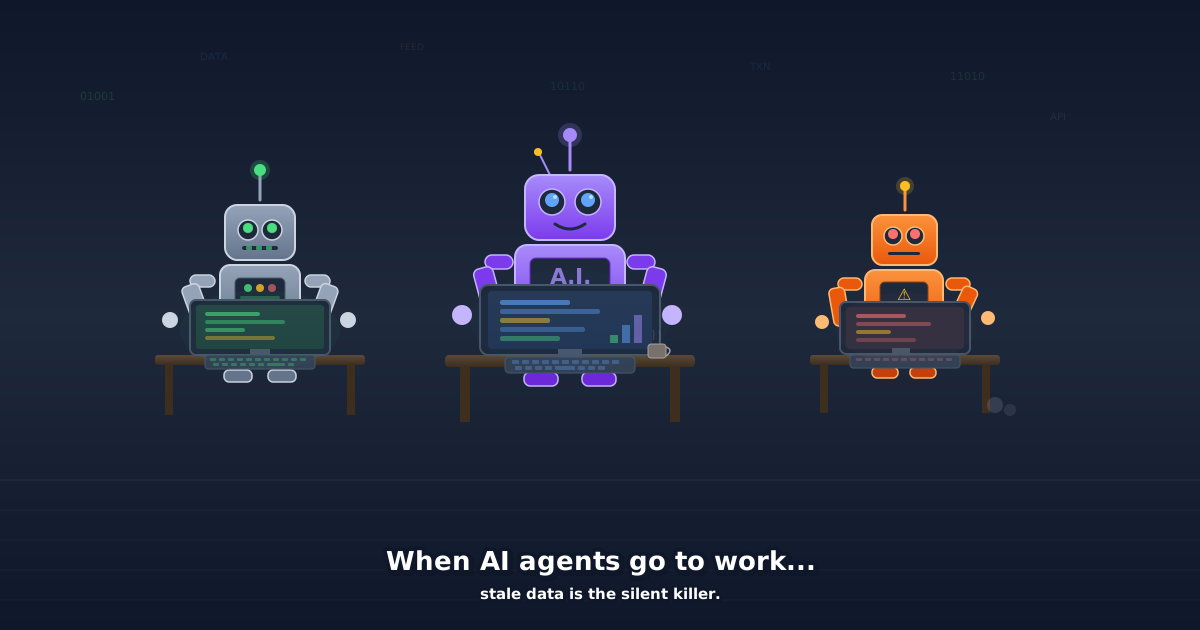
The travel and expense world just got a preview of where enterprise software is heading: AI agents that can autonomously retrieve, reason over, and act on spend data through interfaces built for machines rather than people. A major corporate travel platform recently opened its data layer to agents through a structured protocol. The signal matters more than the announcement. The race to build intelligent spend workflows has started.
Which raises the question every platform builder should be sitting with right now: when your agent reaches for transaction data, what does it actually find?
No one would ship a driverless car that navigates from last night's map
Think about what makes an autonomous vehicle work. It is not a better driving algorithm. It is the perception layer: the thing that tells the car what is on the road at this exact moment, and tells it precisely. Pedestrian. Cyclist. Plastic bag. Refresh that map once a night and the car drives confidently through a world that no longer exists. Blur the labels and it brakes for shadows.
AI agents in spend management sit in exactly the same position. The reasoning is no longer the hard part. The perception layer is.
Freshness is not a feature. It is the foundation.
An agent asked to flag an out of policy expense, reconcile a trip, or surface a cash flow anomaly is only as useful as the data underneath it. Hand it a batch file from last night, or a snapshot from a bank feed delayed 24 to 72 hours, and the agent is reasoning over history rather than reality. It flags a charge that was already voided. It misses the pattern forming right now. The intelligence is real. The data is not.
This is the gap that network direct transaction data closes. When authorizations, clearing events, settlements, voids, and refunds arrive in a single unified feed the moment they occur on the Visa or Mastercard network, an agent finally has something worth reasoning over. Not a reconstruction of what happened. A live record of what is happening.
Structure is the other half of the problem
Speed alone does not save an agent. A transaction that arrives instantly as "SQ *4429 CA" is fast and useless. The agent cannot categorize it, cannot match it to a receipt, cannot tell finance what was actually bought. What it can do is guess, fluently and wrongly, which is worse than staying silent.
Network level data arrives with the fields that make reasoning possible: clean merchant identity, MCC, Level 3 line detail where the merchant provides it, and the full lifecycle of the transaction from authorization through clearing, settlement, void, and refund. That is the difference between an agent that produces answers and an agent that produces evidence.
This is precisely where BYOC changes the equation
Astrada's bring your own card approach lets platforms decouple the software from the card entirely. Rather than depending on a single issuer's data pipeline, or working around an aggregator's refresh cycle, platforms connect once to Astrada's unified API and receive structured transaction data regardless of which card their users carry. No card issuing complexity. No PCI burden to absorb. No lock in to one issuer's roadmap.
For teams designing agent workflows on top of spend data, that architecture is not a nice to have. It is the prerequisite. An agent built on Astrada's network level data layer works from the same authoritative record the networks themselves produce, and it shows in every decision the agent makes.
The agentic era of spend management is arriving faster than most roadmaps planned for
If you are building agents on top of spend data and want to see what network direct feeds look like under the hood, we would be glad to walk you through it.